



如何选择最具成本效益的定位销
作者
下载白皮书There are many ways to align components — the challenge for Design Engineers is choosing the best solution at the lowest cost.
The most common, and often most expensive, Alignment Dowels are manufactured per ISO 8734. These precision ground “parallel” pins provide excellent positional tolerance – at a cost. Ground Dowels require extremely tight hole tolerances. In addition, this solution is typically through hardened for strength or case hardened for wear resistance. If the pin’s sole purpose is for alignment, the heat treating process adds cost without any functional benefit.
SPIROL’s GD100 Ground Hollow Dowel is designed to be a direct replacement for Solid Ground Dowels in alignment applications. This lightweight solution will provide the same positional accuracy as Solid Ground Dowels at a fraction of the cost. Like their solid counterparts, GD100 Ground Hollow Dowels are precision ground and require the same hole tolerances for proper installation and retention. Due to its hollow construction, the GD100 Ground Hollow Dowel is approximately 50% lighter than a Ground Solid Dowel; an important consideration for cost conscious Design Engineers seeking weight reduction without sacrificing performance. The lower weight will also translate into significant savings in freight charges.
Figure 1
SPIROL's GD100 Ground Hollow Dowels used to locate an automotive transmission case to the back of the engine.
Figure 2
From left to right: Ground Parallel Pin per ISO 8734, Ground Hollow Dowel, Dowel Bushing, Spring Dowel, and a Coiled Spring Pin
Although Spring Dowels, Dowel Bushings, and Coiled Spring Pins are not precision ground, they are still capable of accurately projecting hole position for the purpose of alignment. Each of these options is designed to be larger than the hole in which it is retained. The mechanism of retention is compression rather than interference so hole tolerances can be widened and secondary reaming operations can be eliminated to reduce manufacturing costs. The flexibility of these parts also provides much lower insertion force than is required for Ground Solid or Ground Hollow Dowels. The spring characteristics of these parts absorb wide hole tolerances, reduce manufacturing costs, and dramatically reduce component cost when compared to Ground Solid Dowels.
Spring Alignment Dowels and Coiled Pins are often used to accurately position one component to another. Spring Dowels are generally recommended for applications requiring a “dowel” with a length to diameter ratio of 1.5:1 to 4:1. Coiled Pins are generally recommended in applications with greater length to diameter ratios between 4:1 to 10:1.
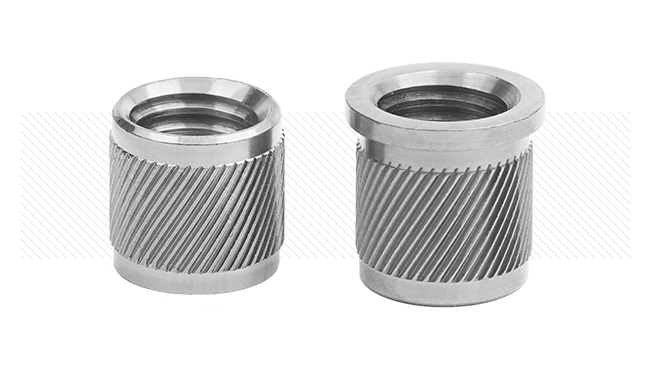
In applications requiring bolts for axial retention, further savings can be achieved by passing the bolt through the inside diameter of a Dowel Bushing (Figure 4). This eliminates the cost associated with drilling a separate hole for the bolt. Dowel Bushings are also hardened to protect the bolt from shear loads, and isolate the forces on the bolt to tension loading to ensure joint integrity.
Figure 3
Spring characteristics of Spring Dowels, Dowel Bushings and Coiled Spring Pins. Retention by outward radial tension.
Figure 4
To select the most cost-effective alignment component Design Engineers must consider:
- Required positional tolerances
- Cost of secondary operations (reaming/honing holes)
- Overall assembly weight
- Associated freight charges
- The Dowel or Pin price
Given the variety of different fasteners that can be used for alignment, Engineers should partner with industry experts to ensure their assembly is equipped with the most cost-effective alignment component that will provide the performance required over the life of the product.
Conclusion
Both Solid Dowels and Hollow Dowels can maintain precision alignment and protect bolts from shear loads. However, Hollow Alignment Dowels are approximately 50% lighter and significantly less expensive than Ground Solid Dowels. In addition, Spring Alignment Dowels further reduce cost by absorbing wider hole tolerances, and eliminating the need to drill a separate hole for a bolt if one is used to fasten the assembly together.


马来西亚
捷克共和国