


间隙对卷制弹性圆柱销剪切属性的影响
作者
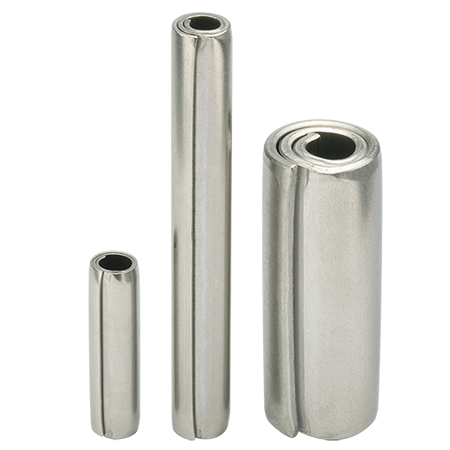
下载白皮书Coiled Spring Pins are used in thousands of applications spanning a wide range of markets. SPIROL evaluates many applications and has identified common design/ manufacturing errors which reduce the strength of pinned joints. These features include, but are not limited to, counterbores, countersinks, and gaps between mating components. These conditions introduce clearance and cause bending which reduce a pin’s effective shear strength.
Coiled Spring Pins are assigned minimum double shear strength values per applicable industry specifications. Due to the Coiled Pin’s dynamic nature, shear values are derived through testing instead of traditional calculation. Testing is conducted per specific criteria as outlined in the specifications such as ASME B18.8.2, ASME B18.8.3M and ISO 8749. Gages are to be hardened steel with a maximum .005” (0.13mm) clearance in the shear planes. This represents ideal conditions and ensures that the pin is in shear. As clearance conditions in assemblies depart from test parameters, the pin will fail in bending – not shear – and strength will begin to degrade. It is critical to understand how deviation from ideal shear conditions affects performance of the pinned joint because it may impact the integrity and longevity of the assembly.
A counterbore or countersink is often added between components with the intention of guiding the pin from one hole into the next. While the intent is understood, resultant gap is often unacceptable. SPIROL’s Coiled Pins are designed with generous chamfers intended to facilitate alignment during installation – therefore countersinks and counterbores are not necessary (Figure 1). These features, though often overlooked, introduce clearance and bending which reduce performance of the pin when loaded in shear. Reduced strength also contributes to fatigue which can lead to premature failure. While the causes of failure may be easy to identify, it is important to quantify the effects of premature failure in order to develop an understanding of their impact.
SPIROL light duty Coiled Pin has been tested with incremental increases in shear plane clearance to better understand the magnitude of change in performance. Light duty pins were selected because they are easily installed and removed. The selected pin is a standard CLDP .250 x 2.500 LBK, or light duty, high carbon steel Coiled Pin with ‘dry to the touch’ corrosion inhibiting oil finish. This pin provides sufficient length to allow testing with various clearances.
Light Duty Coiled Pin
Coiled Spring Pins are designed to install without extra guidance from countersinks or counterbores. The smooth, concentric chamfer combined with square, clean-cut ends translates into trouble-free installation.
Figure 1
A: Countersink clearance area
B: Counterbore clearance area
A standard square ASME B18.8.2 shear block (Figure 2) was used with an Instron Model 3384 for all testing. Two different size washers with an average thickness of .072” (1.83mm) and .120” (3.05mm) were used to increase the spacer distance, and the shear block plunger was centered between the support fixtures. As previously stated, the maximum distance between the shear planes should be .005” (0.13mm) to avoid bending of the pin.
|
|
Figure 3BThe Coiled Pin in bending has curvature on the outside layer and a multiplanar fracture surface |
Visually there is a significant difference between pins failing in bending as opposed to shear. As shown in Figure 3A, pins failing in shear demonstrate fracture in one plane. While the coils are deformed, they appear flat with the outside collapsing in one direction. Figure 3B shows a pin tested with a .120” (3.05mm) gap. In this image, bending clearly occurred as visible from the curvature leading to the fracture surface.
Additionally, the fracture surface is not along one plane but exhibits failure differently at each coil. It is imperative to review both the fracture surfaces of the failed pins as well as the actual host components into which the pins were installed. It is not uncommon for the host components to have features not specified on the drawing that introduce clearance. The root cause can accurately be determined only when reviewing all components in the application.
Thirty samples of each condition were tested and the summary of results is shown in Table 1. Data aligns with the theory that clearance reduces maximum force at fracture. An interesting observation was the smaller change in force occurring between .072” (1.83mm) and .120” (3.05mm). Force required to fracture the pin dropped 18% or around 800 lbs. (3.6 kN) when increasing clearance from .005” (0.13mm) to .072” (1.83mm), but further increasing gap to .120” (3.05mm) resulted in an additional reduction of approximately 150 lbs. (0.7 kN) totaling a 22% change.
Figure 2
Typical pin shear test fixture per ASME B18.8.2
A: Hardened Bushings
B: Load
C: Shear Block
D: Spacer
E: Coiled Pin
F: Cap Screws
G: Support Fixture
H: Spacer & Guides for Shear Block
| .005″ Clearance(Shear) | .072″ Clearance | .120″ Clearance | |
| Mean | 4,257.64 | 3,475.44 | 3,312.54 |
| Min | 4,029.39 | 3,340.20 | 3,211.69 |
| Max | 4,548.73 | 3,583.60 | 3,395.75 |
| St. Dev | 125.77 | 56.21 | 45.94 |
Table 1
Summary data of force (in lbs.) at failure from 30 test samples of CLDP .250 x 2.500 LBK
This phenomenon is explained using general material principles. When evaluating stress-strain behavior, the flexural or bend strength is commonly used to describe brittle ceramics, but it is defined as the stress at fracture due to bending forces. It is a property that is tested through three – or four – point bend testing, which is done in a transverse bend with single or dual loads and underlying supports positioned at a predetermined distance (L). The bend testing models are a simplified representation of a pin with a shear block.
The flexural or bending stress equation is1:
where Ff is the load at fracture, R is the radius of the pin, and L is the distance between supports. As clearance is added symmetrically to increase the distance between support points, L changes to L+2g with g being the added clearance distance on one side. Using the known values, Figure 4 shows the impact of g on the force. Transition from shear to bending occurs rapidly when clearance exceeds the recommended maximum of .005″ (0.13mm). Commensurately, data indicates that the greatest change in strength occurs with minimal deviation from ideal shear conditions. As clearance increases between the assembled components, strength continues to be negatively impacted, but the magnitude of change is not as substantial. In this case with a CLDP .250 x 2.500 LBK, an 18% reduction in force was observed by increasing the clearance from .005” (0.13mm) to .072” (1.83mm).
| σ = Stress |
F = Mc |
| M = Maximum Bending Moment | FL 4 |
| c = distance from center specimen to outer surface | R |
| I = moment of inertia of cross section | πR4 4 |
Figure 4
There is a negative inverse relationship between the gap and load at fracture
Conclusion
Overall it is a common misconception that counterbores or countersinks will improve insertion of the pin and have minimal impact on the strength of the pinned joint. The swaged chamfer on the Coiled Pin directs the pin into the next hole, even when some degree of misalignment exists between the holes, eliminating the need for a counterbore or countersink. Data demonstrates a significant drop in strength of the pin when a small gap is added between shear planes. Using bend strength and principles of three – or four – point bending it is clear that increasing clearance has a negative effect on the load necessary to fracture the parts. When designing new or reevaluating current applications, it is important to minimize space between components to optimize the shear properties of the pin and maximize the useful life of the assembly.
1Callister, William D., “Stress-Strain Behavior” in Materials science and Engineering: An Introduction, 7th ed. New York: Wiley, 2007 pp 447-448


马来西亚
捷克共和国
Figure 3A
Figure 3B