


您当前正在使用较旧的浏览器,或者不支持我们的网站。为了获得最佳体验,请使用更新的浏览器:

哪种奥氏体不锈钢弹性圆柱销最适用于动态载荷?

作者 Michael Pasko, 应用工程师

下载白皮书

Austenitic nickel stainless steel Spring Pins are typically manufactured from grade SAE 302/304 (18-8 (1.4310)). Chemical and physical properties of both grades overlap such that mills may produce a single material capable of certification to either specification. Austenitic stainless steel is most frequently selected for its inherent corrosion resistance. While this material possesses the spring characteristics required for proper function of a Spring Pin, it does work harden if subjected to sufficient loading. Austenitic stainless steel is an excellent material in many, but not all, applications.

Austenitic stainless steel is generally not the best solution for applications where the pin will be subject to dynamic loading at high frequency. Though mills use work hardening to achieve high yield strength, it is critical to understand this is a continuous process. As yield strength increases, ductility decreases. In dynamic applications, vibration, impact, and movement will continue work hardening the pin at a rate commensurate with severity and frequency. Excessive work hardening of austenitic stainless steel can lead to fatigue failure evident as cracking or loss of retention. Both Coiled and Slotted Spring Pins will function properly under the right conditions, though the Coiled Pins’ superior design provides improved endurance.

slotted spring in vs coiled spring pin

Figure 1
Slotted Pin and Coiled Pin

All Spring Pins are designed with a pre-installed diameter larger than the recommended hole. Slotted Spring Pins are manufactured with a gap that allows compression of the pin during installation. This differs from Coiled Spring Pins that are designed with a seam. Once installed, a Spring Pin is held in tension and this provides retention. A Spring Pin may also maintain desired fit and function by dampening vibration and shock which prevents damage and/or deformation of the host hole. A Slotted Pin can only flex along its spine 180°opposite the gap, much like opening and closing a book. This focuses all stress in one location (see Figure 2) leading to rapid fatigue and potential cracking (see Figure 3). Similarly, once the metal has lost ductility, it can no longer recover to maintain tension within the hole.

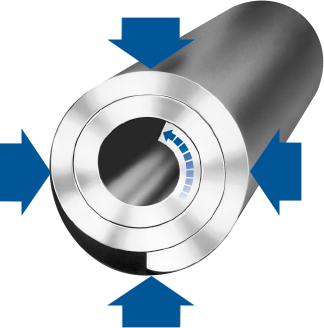
As compared to Slotted Spring Pins, Coiled Spring Pins distribute compressive stress throughout the cross-section by virtue of its helicoidal form; stress is not concentrated in a single part of the pin as is the case with Slotted Pins. As load is applied, the innermost coil is free to travel as demonstrated by Figure 4. Movement occurs in the Coiled Pin’s ØID as it is effectively locked at the outer seam. This approach differs dramatically when compared to a Slotted Pin that can compress only a small amount before butting of the gap occurs. Once a Slotted Pin butts at the gap, no further spring compression is possible. 

sltp inflexility illustration

Figure 2
High stress area of a Slotted Pin

Bucket pin stop crack

Figure 3
A Slotted Pin can only flex along its spine 180° opposite the gap, much like opening and closing a book

cldp flex

Figure 4
Flexibility under load of a Coiled Pin

The following photographs demonstrate fundamental differences in design.

In Figure 5 is a Slotted Pin installed in the nominal recommended hole. Minimal gap remains yet movement is still possible. This may serve to delay work hardening and fatigue – though it will still occur. In this example, once the Slotted Pin is fully compressed under load the seam butts and it will function as a solid tube. This can damage the hole.

In Figure 6, the Slotted Pin is installed in an oversized hole. In this instance there is greater potential for movement since the gap is wider and fatigue can occur more rapidly.

Figure 7 depicts the same diameter Coiled Pin installed in the same nominal recommend hole as shown in Figure 5. The Coiled Pin’s superior roundness is immediately apparent. Rather than the Slotted Pin’s typical ‘tear drop’ shape, the Coiled Pin maintains contact over a minimum 270 degrees of its circumference. The only gap occurs adjacent to the tucked seam which is necessary to ensure the seam does not interact with the hole wall which may lead to skiving or shaving of the material. This area is referred to as the comma area (Figure 8).

Slotted Pin Installed Minimum Hole

Figure 5
Slotted Pin installed in a nominal recommended hole. Notice the gap is virtually closed along the inside diameter of the pin.

Slotted Pin Installed Oversized Hole

Figure 6
Slotted Pin installed in a oversized hole

Coiled Pin Installed

Figure 7
Coiled Pin installed in a nominal recommended hole.

comma ()

Figure 8
A: Comma Area
B: Beveled Edge of Seam

In summation, austenitic stainless steel may be the most cost effective, ideal material for use in some applications although it does have limitations that must be considered in design. Work hardening is of primary concern, though a range of other issues must also be considered. Galvanic corrosion/material compatibility, ability to resist specific corrosive agents/environments, reflectivity, magnetism, and other concerns are less general and more application specific. Coiled Pins are designed to provide optimal performance under the widest possible range of conditions. The benefits of Coiled Pins as compared to Slotted Pins apply across all materials and duties though it may be most evident in product manufactured of austenitic stainless steel. If this material is required, designers must be aware that fatigue is always a potential issue if the pin is subject to dynamic loading. A Coiled Pin will provide superior fatigue life when installed per the recommended design guidelines.

有任何疑问? 我们为您提供帮助!

您有无法解决的制造问题吗?或您有希望得到解答的问题吗?我们的工程专家喜欢迎接挑战。我们致力于为各种应用需求推荐高效的解决方案。电话联系我们或填写下表与我们联系!

+86 021-5046 1451

    Current Page Title: