

您当前正在使用较旧的浏览器,或者不支持我们的网站。为了获得最佳体验,请使用更新的浏览器:

如何选择最大限度延长装配件寿命的紧固件

作者 Christie Jones, 集团副总裁 - 营销总监

下载白皮书

Fasteners are usually the smallest, least expensive components within an assembly. Even though fasteners usually hold the entire assembly together, they are often overlooked until the end of the design. As important as fasteners are, Design Engineers usually receive no formal training on the mechanics of fastening and joining. (Not something you want to think about next time you are on an airplane.)

An assembly can be held together in many ways: bolts, rivets, screws and pins, to name a few. The methods fall into two broad categories: (1) methods that take two components or two operational steps to stay in place; and (2) methods where the components are self-retaining. The challenge for the Design Engineer is to choose a method that provides the highest quality joint with integrity over time at the lowest manufacturing cost. For many applications, a self-retaining pin is the winning solution. The difficulty is selecting the proper pin with the appropriate strength and flexibility for the application. Technically, when a load is applied, something has to give: the pin, the hole, or an element of the assembly. A pin that is too rigid causes the hole in which it is retained to elongate and leads to eventual assembly failure. A pin that is too flexible will fatigue under dynamic loading.

slotted spring pins

Slotted Spring Pins

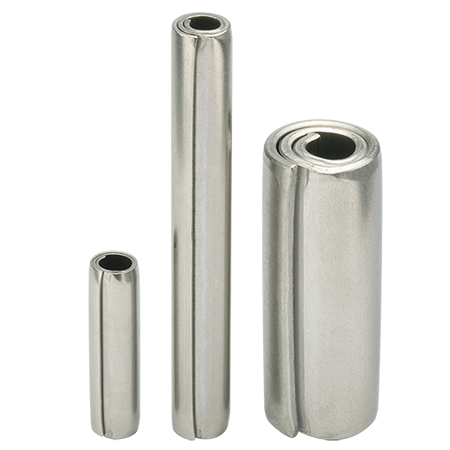
coiled spring pins

Coiled Spring Pins

Slotted Pins

The pins’ flexibility reduces manufacturing costs. However there are several disadvantages to Slotted Pins that limit their applicability in new designs – particularly in those applications with a soft host material, such as aluminum or plastic, which are subject to dynamic loading.

The Solid Pins Slotted Pin is significantly less flexible than the Coiled Pin and it only flexes 180º from the gap. This combination can cause premature assembly failure.

Additionally, Slotted Pins are very difficult to automatically feed and install. The most appropriate applications for Slotted Pins are non-critical assemblies, manufactured out of mild to hardened steel, that are manually assembled.

sltp inflexility illustration

Under load, stress is concentrated 180˚ opposite the gap in Slotted Pins

sltp interlocked

Interlocking does not allow for automatic feeding and installation of Slotted Pins

Coiled Spring Pins

Coiled Pins were invented to address the drawbacks of the Slotted Pins, and to offer the Design Engineer the flexibility to tailor the pin’s strength and flexibility to match the application. This ability to “customize” the function of the pin ensures that each application has the optimum combination of strength and flexibility. Light duty pins are generally recommended for soft or brittle materials. Medium (or standard) duty pins are recommended for use in mild steel and nonferrous assemblies. Heavy duty pins should be used in hardened components.

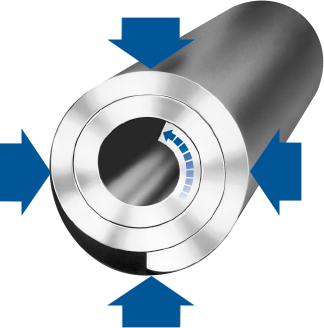
The Coiled Pin is the most capable of absorbing shock and vibration after insertion, therefore providing prolonged useful life of the assembly, and it is conducive for automatic feeding and installation in high volume situations.

cldp flex

The Coiled Pin flexes under load to absorb shock and vibration.

cldp wp coiled pin condition

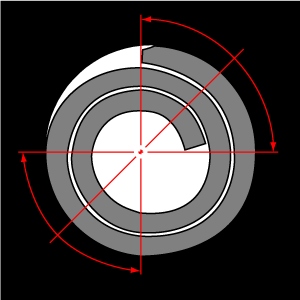
Coiled Pin has 270º contact with the hole

Coiled Pins can be used as hinge pins, alignment pins, stop pins and to fasten multiple components together (e.g.: to pin a gear and shaft). Coiled Pins are not usually recommended as cam followers, or where there is limited length of engagement for the pin. These applications are usually best served by a Solid Pin with retention features.

Considering the many different ways to fasten assemblies, it is recommended that Engineers take advantage of the Application Engineering services provided by the manufacturers of engineered fasteners. By partnering with industry experts in fastening and assembly, Engineers can be assured that their assembly will be equipped with the most cost effective solution that provides exceptional performance and preserves the integrity of the application throughout the life of the product.

有任何疑问? 我们为您提供帮助!

您有无法解决的制造问题吗?或您有希望得到解答的问题吗?我们的工程专家喜欢迎接挑战。我们致力于为各种应用需求推荐高效的解决方案。电话联系我们或填写下表与我们联系!

+86 021-5046 1451

    Current Page Title: