
 CHINA
CHINA Malaysia
  한국
한국  USA
USA  Canada
  United Kingdom
  Deutschland
  México
  Brasil
  Česká republika
  France
  España
 Lowest Installed Cost
By
Download this WhitepaperWhat is the real cost of a component?
When sourcing a fastener this is often taken as the one that costs less. However, it is not that simple and it has been a question that SPIROL has answered for over 50 years and the answer is the one with the lowest installed cost.
So how do we evaluate the lowest installed cost? Lowest installed cost is determined by a number of factors and looks at the cost of actually getting the fastener into place in the assembly. This covers the cost of hole preparation, the method and ease of assembly, the design and manufacturing costs of mating components, the cost of the fastener, the cost of poor quality (scrap) and the general satisfaction level of the final customer. The highest cost is when a customer chooses a competitor product.
Component Cost
In most situations the fastener is the least expensive component in the assembly, usually a small fraction of the total cost. It is however the most important element, as the fastener ties the whole assembly together and without the fastener each part is essentially worthless.
Decision making based on piece price alone
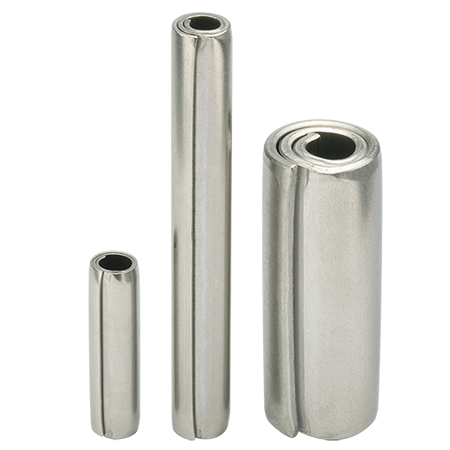
As an example of choosing a fastener purely on piece price and the effect it can have, it is apparent when we compare the difference between types of spring pin, specifically the Coiled Pin, and ISO Slotted Pin — SPIROL manufactures both. Looking at the piece price alone the decision would be to use the Slotted Pin, as it is approximately 20% cheaper Typically in the cosmetic packaging industry powder compacts were hinged using solid pins or even metal wire cropped to length. In an industry where margins are small and volumes high, the item with the cheapest price was the driving factor. However, with increasing quality demands, and the need to eliminate scrap, and failures in than the Coiled Pin. However, the Coiled Pin has significant advantages over the Slotted Pin that enable the pin to be installed much more easily and at less cost. Let us look at the different issues.
- Hole preparation – Hole preparation can be costly. Using a solid pin means two operations drilling and reaming. Using a spring pin eliminates the reaming process, but using the Coiled Pin, which can be installed in wider hole tolerances, means saving on drill changeovers and reduced inspection.
- Ease of assembly – ISO Slotted Pins are not round. Neither do they have any controlled maximum chamfer diameter. This makes it possible for the pin to be produced with a lead in that could be the same size as the hole. This creates insertion problems and hole damage. Where the Slotted Pin is used in high volume situations and automated feeding and assembly of the pin is required, the insertion problems increase the cost of the assembly equipment by requiring larger equipment. On top of this, the Slotted Pins interlock and this requires expensive methods of de nesting to be added to the machine to ensure that they feed trouble free. Coiled Pins have controlled chamfers, are rounder and because they have no slot, do not interlock.
- Poor Quality – Damage to the hole during insertion can lead to premature failure of the assembly or scrap products. The result of such damage is loosening of the pin in the hole and the subsequent reduction in the shear resistance. Worse, the pin could simply work out and the assembly falls apart. Coiled Pins have swaged chamfers that reduce hole damage and are inserted at less pressure than Slotted Pins.
Case Study
The following is a case study in how basing purchasing decisions on piece price rather than lowest installed cost can in the end prove more expensive. In this situation we are focusing on the cosmetic powder compact.
Typically in the cosmetic packaging industry powder compacts were hinged using solid pins or even metal wire cropped to length. In an industry where margins are small and volumes high, the item with the cheapest price was the driving factor. However, with increasing quality demands, and the need to eliminate scrap, and failures in the field, moulders and the cosmetic manufacturers alike are seeking better ways to produce the case hinges.
The common practice of the moulder was to design misalignment into the holes to create a friction hinge. This was in response to the demand from the cosmetic companies for the lid of the compact to be able to be held open for display purposes and create a smooth hinge action. The pins were normally assembled at the moulding machine whilst the plastic is hot which made assembly easier but as the component cools and shrinks the unyielding pin generates stress on the plastic. This result was hinges cracking and failure of the compact. Scrap levels were considerable, not only during the moulding and assembly process but also from the field which resulted in returns from customers. Allied to this was a problem with output. It was easy to mould the compacts but assembling such a small pin was problematic Technical Centers especially with cropped wire that had ends with burrs and would not enter easily into the holes.

Coiled Pins – The Lowest Installed Cost
Coiled Pins are rapidly becoming the fastener of choice for plastics, because they conform readily to the holes and also because they distribute stress uniformly throughout the host component.
Because the pin is a helical spring throughout its length and has smooth swaged chamfers, it accommodates small misalignments and minor diameter variances between mating parts as it is being inserted. Due to the radial pressure of the pin in the hole it is no longer necessary to design and mould in misalignment to create the friction hinge. This significantly reduces scrap and rejects. Another cost reduction improvement using the Coiled Pin is reduced assembly time. Typically the pins used in this application are less than 1.5mm in diameter and this in itself was a problem to handle. Couple the Coiled Pin with the automatic Model HC horizontal, dual pin insertion machine, specifically developed by SPIROL for this application, and productivity is also increased significantly.

Model HC
Whilst the component cost of the Coiled Pin may be higher than that of a solid pin or wire, the advantages that the Coiled Pin offered through reduced scrap, faster assembly, and improved customer satisfaction actually lowered the total component cost.
This is the concept of lowest installed cost. It is one that can be applied to any assembly process and therefore provides customers with an answer to this complex question.