

 CHINA
CHINA Malaysia
  한국
한국  USA
USA  Canada
  United Kingdom
  Deutschland
  México
  Brasil
  Česká republika
  France
  España
 Performance Expectations for Threaded Inserts in Plastic Assemblies
By
Download this Whitepaper
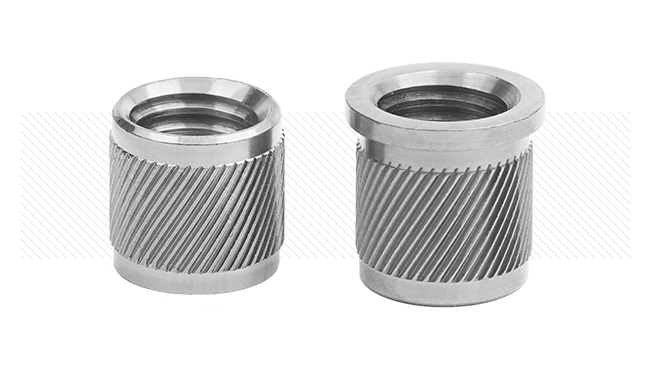
The use of Threaded Inserts in plastic assemblies allow designers to replace machined and cast metal components with plastic to achieve significant cost and weight savings without any loss of joint strength.
Some of the most common questions asked by designers are “What kind of performance can I expect from this type of Insert?” – and – “Will this Insert meet the performance specification on my drawing?” While on the surface these questions seem relatively easy to answer, it’s actually nearly impossible to answer with a simple “yes” or “no;” but rather “it depends.”
Insert performance, or resistance to rotational torque and tensile loading (also known as pull-out), is only partially influenced by the Insert itself. Other factors that impact Insert performance include:
- Plastic material and filler composition,
- Design and quality of the plastic components including hole consistency,
- Installation process and resultant quality, and
- Alignment of the mating component and how it supports the installed Insert.
There are so many different combinations of Insert materials, plastic types, and assembly configurations (local to the joint) that without understanding these factors, it is impossible to determine what performance could be achieved in a specific application. Additionally, as much as 75% of the Insert’s performance is a direct result of how well it was installed.

Threaded Insert performance testing methods: (left) tensile (pull-out) strength and (right) rotational torque
In order to establish a true benchmark for an application, it is imperative to assemble and test the bolted joint under the application’s production environment. Since questions surrounding performance often arise earlier in the design process, it is important to consider which of the previously listed factors may be easily adjusted compared to those with a more significant impact if modified. An Insert can be recommended to meet a specific application’s requirements in the design stage, and/or modifications can be proposed to an existing assembly to optimize performance based on prior experience and extensive performance data. In some cases, it is preferred to test the Insert in the application to determine the installation criteria that will yield the best performance. Ultimately, acceptance of any Threaded Insert is subject to testing and evaluation to confirm performance in the actual application.
Once a benchmark has been established and the application moves into production, it is imperative to remember that variation to any of the aforementioned factors may affect the Threaded Insert’s ability to resist rotational torque and pull out. Limiting the number of suppliers involved with an assembly can also minimize variables that affect performance. Therefore, if possible, purchase both the Threaded Inserts and Installation Equipment from the same supplier.
Many Insert manufacturers provide performance data in their product catalog. This data should be used solely as a comparative guide for Insert types and sizes. This performance data should not be used to compare across manufacturers since testing methods and materials are not consistent, nor should it be used to estimate a performance benchmark.
Conclusion
Given the variety of plastic materials and fillers and the complexity of component design, it is impossible to provide Insert performance data which can be applied to specific applications. It is recommended that designers partner with Application Engineering experts who specialize in Threaded Inserts for Plastics as early as possible in the design stage to determine the most appropriate Insert for their assembly. Final approval of the Threaded Insert should always be based on testing and approval in the actual application.