

 CHINA
CHINA Malaysia
  한국
한국  USA
USA  Canada
  United Kingdom
  Deutschland
  México
  Brasil
  Česká republika
  France
  España
 Slotted Pin Inflexibility Leads to Failure
By
Download this WhitepaperA “Spring Pin” is appropriately named by its ability to flex into a hole that is smaller than the pin’s original (pre-installed) outside diameter. A Spring Pin’s tendency to return to its original shape after installation makes the pin self-retaining. Retention is established by friction between the pin and host wall and not by deformation as with alternative solid press fit pins. In general, this concept of preserving joining components (both pin and host) during installation increases the life of dynamic assemblies.

The term Spring Pin commonly describes both Coiled Pins and Slotted Pins. While the concept and naming of Coiled Pins and Slotted Pins may be interchangeable, there are distinct differences between the two pins.
As a Slotted Pin is installed, the pin’s “spring-like” characteristic is reduced to a narrow seam opposite the slot. Here, stress concentrations form as a result of the pin’s limited flexibility. This portion of the Slotted Pin is susceptible to failure if the pin is subject to impact loads.
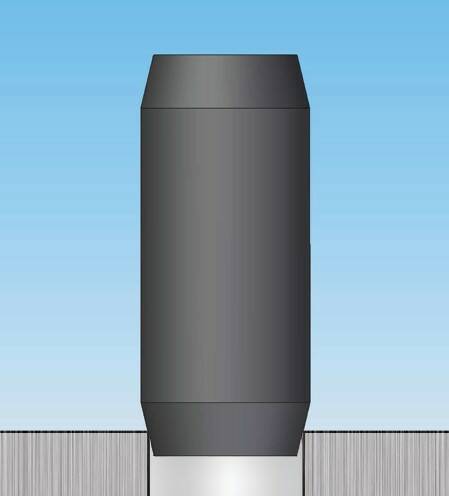
A second mode of failure is caused by the Slotted Pin’s rigidity after installation. When a Slotted Pin is installed, the slot closes and the pin can act like a rigid hollow tube. This tube behaves similarly to a Solid Pin. As a solid member, impact loads are transmitted to the host wall; causing hole elongation. As the hole size increases, impact loads intensify, and failure is accelerated. The pin cracks, falls out of the hole, or does both.

Stress concentrations

Direction of impact load and resulting hole elongation.

The solution to these problems is SPIROL’s Coiled Pin. As the Coiled Pin is installed, stress is distributed throughout the fastener instead of being concentrated along a line. The Coiled Pin’s design also ensures flexibility after installation. For the life of the assembly, the Coiled Pin is able to absorb impact loads without causing damage to the host or the pin. Unlike the Slotted Pin, it remains an active member of the joint, continuously absorbing loads.
Exemplifying the differences between the Coiled Pin and the Slotted Pin in demanding, high-impact applications, the following case study could apply to many similar applications.
Case Study
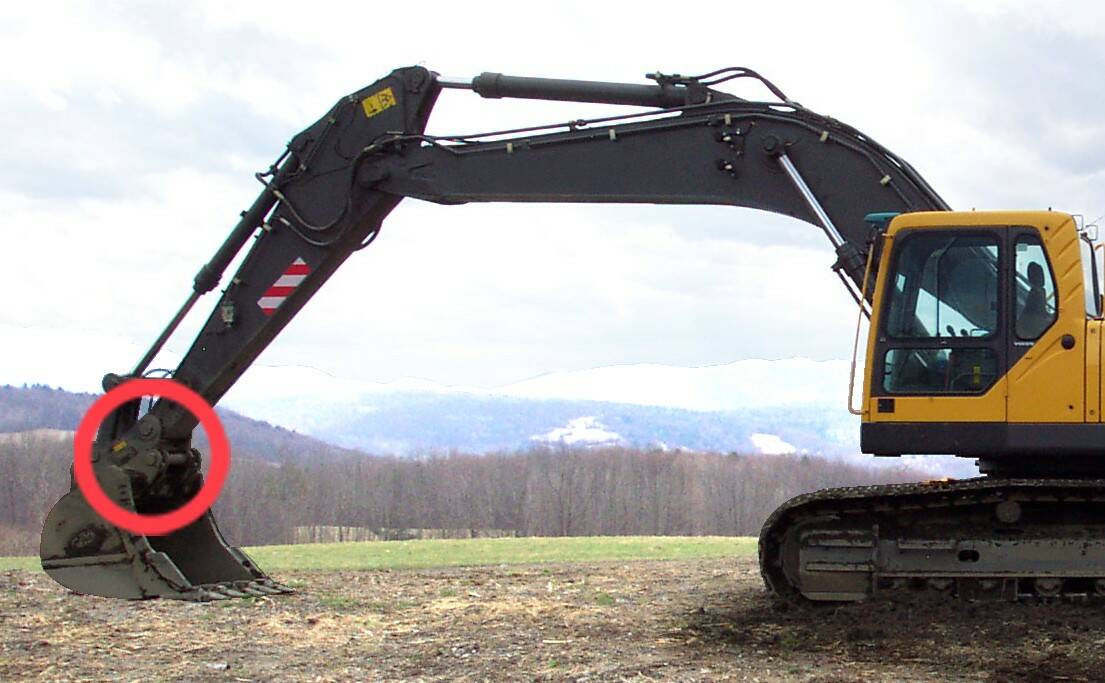 Quick couplers are designed to maximize construction site productivity by enabling excavators to perform various jobs, sometimes all in the same day. Quick couplers increase the excavator’s versatility by allowing attachments for digging, grading, and compacting to be changed in minutes. The reliability and performance of couplers is critical to the productivity of a construction site. If a coupler fails to work properly, the resulting down time is very costly. Job site safety also depends on the coupler’s performance. If a coupler unintentionally releases, a falling attachment can cause serious injury.
Prototype 1
A coupler manufacturer was challenged to design a stop feature that could withstand high impact loads. The coupler requires a positive stop to control the stroke of the hydraulic lever each time an attachment is released. In the coupler shown to the right, the manufacturer used a Slotted Pin as the stop mechanism. The crack shown in the lower picture is a result of the Slotted Pin’s limited flexibility. Because the Slotted Pin is not able to easily conform to the hole size, it folds and creates a limited interference fit at 3 points to the hole. This causes stress to concentrate 180º from the slot. Over time, this weak area was exacerbated by impact loads, leading to failure. The Slotted Pin was at risk to fall out of the hole and the productivity and safety of the construction site was compromised.


Prototype 2
In an attempt to correct this issue, the manufacturer inserted a second Slotted Pin into the first, called Composite Pinning. While the result is a stronger, more rigid pin, problems normally arise with this configuration. In order to function, it is critical that the gaps of each Slotted Pin are oriented 180º to each other. It is also critical for the seam of the inner Slotted Pin to butt prior to seam of the outer pin. If the outer pin butt’s first, the inner pin provides no additional strength. Even if the correct design is accomplished, Composite Pins are labor intensive and prone to human error during assembly. The higher rigidity of the composite pin can also cause hole damage, just as a Solid Pin would. Initially, in this application, the Composite Pin was able to withstand more cycles, but, over time, the same cracking problem occurred. Stress concentrations that were inherent to the Slotted Pin’s design continued to cause failure opposite to the seam. This more expensive and cumbersome design was only a short term solution.

Composite Pinning: Slotted pins are oriented 180˚ from each other.
SPIROL Solution
The coupler manufacturer contacted SPIROL for assistance. SPIROL’s Application Engineering Team reviewed the coupler design and the manufacturer’s performance objectives. A heavy duty Coiled Pin was recommended for the pin’s unique combination of strength and f lexibility. The heavy duty Coiled Pin is progressively rolled with thinner gauge strip, yet the additional cross sectional material achieves greater strength than the Slotted Pin. This creates a strong pin with increased flexibility, making the pin able to withstand impact loads and provide long-term joint integrity. There is no single point of stress concentration, and the hole size is preserved. The Coiled Pin saved the customer on piece price, assembly costs, and reduced warranty claims. It also enhanced workplace safety.

A rendering of the SPIROL Coiled Pin Solution: No orientation of the coiled pins is required.