

 CHINA
CHINA Malaysia
  한국
한국  USA
USA  Canada
  United Kingdom
  Deutschland
  México
  Brasil
  Česká republika
  France
  España
 Heat vs Ultrasonic Installation of Inserts in Plastic Assemblies
By
Download this WhitepaperIntroduction
The focus of this article is on two of the most commonly used Insert installation methods in thermoplastic parts: heat and ultrasonic installation.
As the usage of plastic parts has increased in a wide array of industries, the methods for fastening have become increasingly important. When screws or bolts are threaded directly into plastic components, failures can occur due to stripped threads or plastic creep1. In situations where joint strength and the ability to assemble and disassemble without degradation of components is required, Threaded Inserts provide a serviceable thread which satisfies both of these needs.
Before going into detail on heat versus ultrasonic installation, it is important to note that there are other methods for installing Inserts, as shown in Table 1. Installation of Inserts after molding (post mold) versus molding-in reduces costs by shortening molding time. Post mold installation also reduces the chance of scrap and potential mold damage resulting from dislodged Inserts. As shown in Table 1, heat and ultrasonic installation is only used with thermoplastic parts. Thermoplastics are solid at normal temperatures and can be re-melted a number of times, whereas thermosets have a one-time reaction in their conversion from liquid to solid and cannot be re-melted.
| INSTALLATION METHODS FOR THREADED INSERTS | ||
| Installation Method | Thermoplastic | Thermoset |
| Heat | ✓ | |
| Ultrasonic | ✓ | |
| Press-In | ✓ | ✓ |
| Self-Tapping | ✓ | ✓ |
| Mold-In | ✓ | ✓ |
Table 1
✓ = can be installed in designated plastic type
1Creep refers to material deformation or movement when the material is exposed to static mechanical stresses and/or elevated temperatures. (Materials Science and Engineering An Introduction, William D. Callister, 7th Edition).

Figure 1
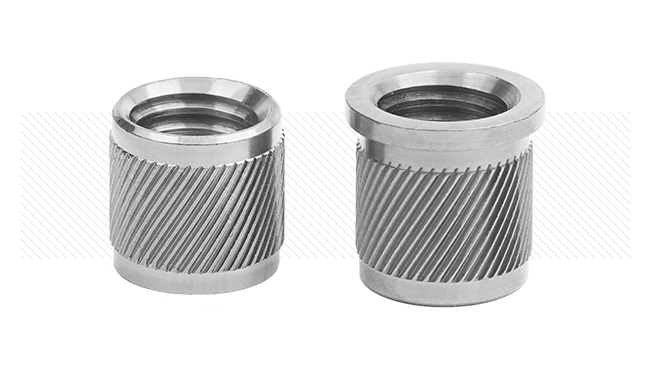
Undercuts, knurls and/or threads on the outside of the Insert improve performance
With both heat and ultrasonic installation methods, the Insert is embedded into a molded or drilled hole through re-melting of the plastic. Retention within the hole is provided by the melted plastic conforming to the external features of the Insert (Figure 1). A sufficient volume of plastic must be displaced to entirely fill these external features so that the Insert achieves maximum performance when the plastic solidifies. An accurate way of determining sufficient plastic flow into the knurls, barbs and undercuts of the Insert is to take a cross section of the installed Insert and ensure that the features are mirrored in the plastic as shown in Figures 2 and 3. It is extremely important to ensure proper plastic flow into the features of the Insert as this dictates the torque and pull-out performance. In Figure 3, the plastic did not sufficiently flow into the retention features, which will result in low Insert performance.
Though they are both dependent on localized melting of the plastic, heat and ultrasonic installation methods can result in varying performance. Both installation methods have advantages and disadvantages, which should be considered before investing in installation equipment.

Figure 2
Proper plastic flow

Figure 3
Improper plastic flow
General Descriptions
Ultrasonic Installation

An ultrasonic insertion machine converts electrical power into a mechanical vibratory output. The downward force is typically provided by a pneumatic cylinder while ultrasonic horn delivers mechanical energy to the metal-plastic interface. Ultrasonic horns (manufactured from various metals including titanium alloys, stainless steel and aluminum alloys) directly contact the metal Insert. As the horn vibrates, the mechanical energy is transferred to the plastic surrounding the Insert creating heat – and ultimately the melting – necessary for insertion.
Heat Installation

Heat insertion of Inserts is accomplished by transfer of heat from the heated tip through the Insert to the plastic, or by preheating the Inserts and then pressing them in. In both cases, a controlled force is applied to the Insert to ensure that the plastic is sufficiently melted before the Insert is installed. Since heat installation requires heating the entire Insert and not just the metal-plastic interface, the Insert material should have excellent thermal conductivity (brass and aluminum are common choices). This enables the Insert to efficiently transfer heat to the plastic. (It also enables the Insert to cool down quickly after installation). Once the plastic reaches its melting temperature, it begins to fill the retention features of the Insert and then solidifies while inducing minimal stress.
Primary Features, Benefits, and Limitations of Ultrasonic and Heat Insertion
Due to faster insertion and shorter cooling time, ultrasonic insertion typically has a shorter cycle time than heat insertion when installing a single Insert that has not been preheated. However, heat equipment that preheats the Insert will have comparable installation time as compared to ultrasonic equipment. In addition, when installing multiple Inserts simultaneously, heat insertion will offer faster throughput.
Advantages of Ultrasonic Installation
Short cycle time for small Inserts – Ultrasonic installation is generally fast for smaller Inserts (under 1/4” OD), and slows as the Insert size increases.
Can be repurposed – Ultrasonic machines are often re-utilized, or converted from an initial plastic-toplastic welding process to Insert installation.
Interchangeability – Horn sizes and shapes can be easily changed to accommodate different Insert sizes.
Disadvantages of Ultrasonic Installation
Insufficient melt
- Poor fixturing/clamping of components often times results in cold pressing the Insert. This happens because of damping, which refers to the dissipation of mechanical energy. The damping effect results in poor installation because the mechanical energy is not being localized around the Insert.
- When Inserts are driven too quickly, the plastic does not have time to fully melt. This is a common problem with ultrasonic insertion that often causes high stress and poor retention within the plastic that can lead to part failure. Failure can happen during installation, but the worst case scenario is when failure happens in the field.
- The vibratory forces applied via the horn are difficult to control and sometimes parts are forced into the hole before melting has occurred at all. Damage to the Insert or the plastic host can be severe. While sophisticated control systems can help solve this problem, they can nearly double the cost of an already expensive ultrasonic insertion machine.
- Slight size variations of the Insert and/or hole can be enough to cause insufficient melt – even when the speed of the insertion is slowed down.
Metal particulates and flakes – Metal particulates and flakes may appear when the ultrasonic horn vibrates against the Insert and chips off the Insert material.
Excessive noise – Significant noise problem caused by metal to metal (ultrasonic horn to Insert) contact. The bigger the Insert, the louder the noise will be during installation.
Difficult to install multiple inserts simultaneously – It becomes very costly, if not impossible, to install multiple Inserts at the same time.
Insert damage – Incorrect frequency and/or incorrect down force can cause damage to the Insert. In some cases, the ultrasonic horn can cause damage to the Insert threads, which results in not being able to install the screw or bolt.
Non-headed inserts – Extra caution needs to be taken when using non-headed Inserts to ensure proper contact surface is made between the Insert and the horn. Otherwise, damage to the internal threads are likely to occur.
Ultrasonic horns are expensive – Ultrasonic horns are subject to wear and are very expensive to replace. It is common for them to exceed $1,000.
Advantages of Heat Installation
Reliable & consistent – Lower installation forces enable insertion into thin-walled parts which would be destroyed by ultrasonic equipment. With consistent and adjustable temperature, force and depth settings, an installed Insert with predictable pull-out and torsion failure forces can be designed for the application.
Quiet – Quiet operation eliminates the harsh noise associated with ultrasonic installation.
More economical – Heat installation machines are about 50% less expensive than similar ultrasonic equipment because they are less complex and do not require as many components. Heat installation is comprised of using a heated tip and the insertion force is pneumatically driven under low force; generally under 50 lbs. Ultrasonic installation requires an electronic power supply, cycle controlling timers, an electrical or mechanical energy transducer, and an ultrasonic horn.
Easy insertion into deep recesses – Longer heat tips can be used to enable insertion into deep recesses within a part which would be inaccessible to an ultrasonic horn.
Versatile
- The heat installation method is extremely adaptable. Applications that need multiple Inserts on multiple planes can be catered to with platen style heat machines. Prototyping or low volume applications can be catered to with a manual heat machine.
- Wide range of Insert sizes can be accommodated on the same machine by switching out the interchangeable heat tips.
- Any Insert can be installed – headed or nonheaded.
- Heat insertion modules can be equipped with vibratory bowl feeders so that the operator does not need to physically touch the Insert during the entire installation process. The Inserts would simply be loaded into a vibratory feeder and advance through the feed tube to a guarded heating chamber. The operator would then load the plastic molded component into the fixture, and activate the machine to install the Insert.
– This is extremely important for very small Inserts, which are difficult to singulate and orient.
Minimal maintenance – Heat machines seldom need maintenance (if ever). The maintenance and spare part costs are low, replacement heat tips are approximately $55.
Higher performance – Generally, higher performance can be expected from heat installation because of the “through-heating” of the Insert. This enables the melted plastic to fully flow into all retention features. Performance of Inserts that are ultrasonically installed is often times lower because the plastic is not able to fully flow into retention features. This happens because of the minimal heating generated only at the point of interference between the Insert and the host.
Potential Disadvantages of Heat Installation
Longer process time – Heat insertion’s slightly longer process time for installation of a single Insert (when the Insert is not preheated) is balanced by its many advantages over ultrasonic installation.
The flexibility, consistency, high performance, and price of heat insertion make it the best choice for installing Inserts into plastic for many applications.
Conclusion
As much as 75% of the Insert’s performance is a direct result of how well it was installed, therefore all of the factors that impact installation must be carefully controlled in order to maximize performance. With so many different combinations of Insert types, plastic types, and performance requirements, it is recommended that manufacturers partner with industry experts in fastening and assembly of Insert products. Proper choice of the Insert and the installation process can be the difference between part failure in the field and part integrity for the intended life of the assembly.